UN Millennium Development Goals Report 2008

Cover of UN MDG Report 2008In August 2008, the United Nations published the latest edition of its annual report on progress toward the Millennium Development Goals (MDG). The Millennium Development Goals Report 2008 presents data for each of the eight MDGs.
  1. Eradicate extreme poverty and hunger
  2. Achieve universal primary education
  3. Promote gender equality and empower women
  4. Reduce child mortality
  5. Improve maternal health
  6. Combat HIV/AIDS, malaria and other diseases
  7. Ensure environmental sustainability
  8. Develop a global partnership for development
In the section on MDG 2, universal primary education, trends in primary school enrollment from 1991 to 2006 are shown for each MDG region. One region, the Commonwealth of Independent States, is further divided into countries in Europe and Asia. No data are provided for the Oceania region.

Primary school net enrollment rate, 1991-2006
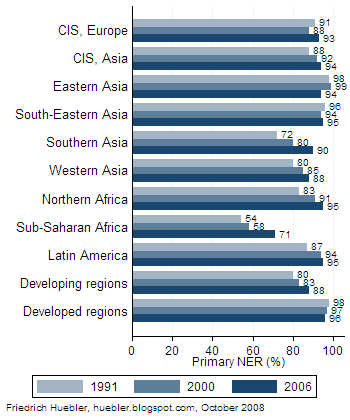
Bar graph with regional primary school net enrollment rates from 1991 to 2006
Source: United Nations, The Millennium Development Goals Report 2008, page 12.

Six MDG regions have reached primary school net enrollment rates at or above 90 percent: Commonwealth of Independent States (Europe and Asia), Eastern Asia, South-Eastern Asia, Southern Asia, Northern Africa, and Latin America. Western Asia is slightly behind with a primary NER of 88 percent. In absolute terms, Sub-Saharan Africa has made the most progress since the turn of the millennium, with a 13 percent increase in the primary NER from 58 percent in 2000 to 71 percent in 2006. This increase was achieved in spite of strong growth in the population of primary school age. Still, three out of ten children of primary school age in Sub-Saharan Africa are not enrolled in primary school. In all developing regions combined, the primary NER rose from 80 percent in 1991 to 88 percent in 2006. In contrast, the primary NER in the developed regions declined from 98 percent in 1991 to 96 percent in 2006.

References
  • United Nations. 2008. The millennium development goals report 2008. New York: United Nations. (Download PDF document, 3.3 MB)
Related articles
External links
Friedrich Huebler, 17 October 2008, Creative Commons License
Permanent URL: http://huebler.blogspot.com/2008/10/mdg-report.html
Education disparity in South Asia

Cover of "Beyond gender: Measuring disparity in South Asia using an education parity index" by Friedrich HueblerA new publication by Friedrich Huebler describes education disparity in the countries of South Asia. The report Beyond gender: Measuring disparity in South Asia using an education parity index was published by the UNICEF regional office for South Asia in its series of papers on girls' education.

Analysis of disparities in national education systems is often limited to gender although other dimensions of disparity are also important. The publication presents data on disparity in primary and secondary education by gender, area of residence and household wealth for countries in South Asia.

To facilitate the interpretation of complex data a newly developed Education Parity Index is introduced. The EPI combines information on disparities across different education indicators and across different groups of disaggregation. This distinguishes the EPI from existing indicators of disparity in education, including the gender parity index and the EFA development index. The EPI is flexible and can be modified according to national priorities, for example by including information on disparities between different ethnic groups.

The use of the EPI as a tool to assess education disparities is illustrated with household survey data from Afghanistan, Bangladesh, India, Nepal and Pakistan. For each country, the report describes how the EPI is calculated. In addition, national trends in education disparity from 1996 to 2006 are presented.

References
  • Huebler, Friedrich. 2008. Beyond gender: Measuring disparity in South Asia using an education parity index. Kathmandu: UNICEF. (Download PDF document, 194 KB)
External links
Related articles
Friedrich Huebler, 12 October 2008 (edited 9 September 2012), Creative Commons License
Permanent URL: http://huebler.blogspot.com/2008/10/epi.html

Child labor and school attendance

A previous article on child labor on this site presented a definition of child labor that considers both economic activity and household chores. The inclusion of household chores leads to a more precise measure of the burden of work on children. In particular, this new child labor indicator is less biased against girls, who typically spend more time on household chores and less time on economic activity than boys.

In the graph below, the proposed child labor indicator is used to evaluate the trade-off between child labor and school attendance among children aged 7 to 14 years in 35 developing countries. This age group was selected because in all 35 countries children are expected to enter primary school by age 7. The underlying data were collected with 26 Multiple Indicator Cluster Surveys (MICS) and 9 Demographic and Health Surveys (DHS) between 1999 and 2005. 34 of the surveys are nationally representative and one, Palestinians in Syria, is a subnational sample. Surveys conducted during school vacation were excluded from the analysis. The results therefore show the trade-off between child labor and school attendance during a time of the year when children are supposed to be in school.

School attendance refers to attendance of any type of school and not only schools that are part of the formal system of education. In addition, children of secondary school age who are still in primary school are also counted as attending school for the purpose of the present analysis. In contrast, such overage children are counted as out of school when indicators like the secondary school net attendance rate (NAR) are calculated. In a further simplification, child labor is defined for all ages as at least one hour of economic activity or 28 or more hours of household chores per week.

Child labor and school attendance, children 7-14 years
Scatter plot with child labor and school attendance rates in 35 countries
Data source: Demographic and Health Surveys (DHS), Multiple Indicator Cluster Surveys (MICS), 1999-2005.

The scatter plot above demonstrates the trade-off between child labor and school attendance. Countries with low child labor rates typically have high school attendance rates and vice versa. A linear regression shows that a 10 point increase in child labor is associated with a 7.6 point decrease in school attendance at the national level.

On average across the 35 countries in the sample, 77 percent of 7- to 14-year-olds attended school at the time of they survey. In ten countries, at least 90 percent of children were in school. In seven countries - Central African Republic, Chad, Guinea-Bissau, Mali, Niger, Sierra Leone, and Somalia - less than half of all children went to school. Somalia has by far the lowest attendance rate with 19 percent.

25 percent of all children between 7 and 14 years were engaged in child labor, ranging from 4 percent among Palestinians in Syria to 78 percent in Niger and Sierra Leone. In six countries, more than half of all children in this age group were child laborers: Central African Republic, Chad, Guinea-Bissau, Niger, Sierra Leone, and Uganda.

Related articlesExternal links
Friedrich Huebler, 5 October 2008, Creative Commons License
Permanent URL: http://huebler.blogspot.com/2008/10/child-labor.html