Child labor: economic activity and household chores

Child labor is one of the obstacles on the way to the Millennium Development Goal of universal primary education by 2015. In a report on global child labor trends, the International Labour Organization (ILO) estimates that there are 218 million child laborers worldwide. 126 million of these children are estimated to be engaged in hazardous work (ILO 2006). The concept of child labor used by the ILO is derived from two conventions: ILO Convention 138, which sets 15 years as the general minimum age for employment, and ILO Convention 182 on the worst forms of child labor. Any work in violation of Conventions 138 and 182 is considered illegal child labor that should be eliminated.

One limitation of statistics like those published by the ILO is that they only refer to economic activity, that is work related to the production of goods and services, as defined in the United Nations System of National Accounts (UNSD 2001). This definition excludes chores undertaken in a person's own household like cooking, cleaning or caring for children.

Statistics of child labor that ignore household chores are problematic because they underestimate the burden of work on children, especially for girls. To examine the relative burden of economic activities and household chores carried out by children, data from 35 household surveys were analyzed for this article. Grouped by Millennium Development Region, these surveys are:
  • Developed countries: Albania.
  • Eastern Asia: Mongolia.
  • South-eastern Asia: Lao PDR, Philippines.
  • Southern Asia: India.
  • Western Asia: Bahrain, Lebanon, Palestinians in Syria.
  • Sub-Saharan Africa: Angola, Burundi, Central African Republic, Chad, Comoros, Congo, Côte d'Ivoire, Democratic Republic of the Congo, Gambia, Guinea, Guinea-Bissau, Kenya, Lesotho, Malawi, Mali, Niger, Senegal, Sierra Leone, Somalia, Swaziland, Tanzania, Uganda.
  • Latin America and the Caribbean: Bolivia, Colombia, Dominican Republic, Nicaragua, Trinidad and Tobago.
The surveys were conducted between 1999 and 2005. 26 of the surveys were Multiple Indicator Cluster Surveys (MICS) and 9 were Demographic and Health Surveys (DHS). All 35 surveys collected data on work by children in the week preceding the survey. Surveys conducted during school vacation were excluded because the focus of the present analysis is work by children that should have been in school at the time of the survey.

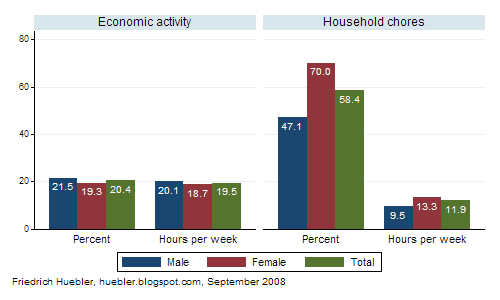
The share of children aged 7 to 14 years in economic activity and household chores is depicted in the following graph. The graph also displays the number of hours spent per week on both types of work. All numbers are averages across the 35 surveys, weighted by each country's population between 7 and 14 years.

Economic activity and household chores, children 7-14 years
Graph showing the link between household wealth and average years of education
Data source: 35 DHS and MICS surveys, 1999-2005.

The results confirm that boys are more likely to be engaged in economic activity while girls are more likely to do household chores. On average across the 35 surveys, 22 percent of all boys and 19 percent of all girls between 7 and 14 years are engaged in economic activity. Boys also spend more hours on economic activity than girls, 20 compared to 19 hours. By comparison, girls are much more likely than boys to do household chores. 70 percent of all girls and 47 percent of all boys did household chores in the week preceding the survey. On average, girls spent 13 hours and boys 10 hours per week on household chores.

What are the implications of these findings for statistics of child labor, as currently defined by the ILO? Take the case of two families that need additional income to provide food for everyone in the household. In the first family, a 10-year-old boy is withdrawn from school and put to work on a farm. Because such work is considered economic activity the number of child laborers goes up. In the second family, the mother decides to start working on a farm and her 10-year-old daughter is asked to stay at home to care for her younger siblings. Because the girl is engaged in household chores the number of child laborers does not change. The consequences are the same for both children: they no longer go to school and miss out on the benefits from education.

To address the limitations of the ILO's definition of child labor, UNICEF has developed an expanded definition that covers household chores in addition to economic activity. This revised indicator is the basis for the child labor estimates that are reported in publications like Progress for Children (UNICEF 2007a) or The State of the World’s Children (UNICEF 2007b). For children 5 to 17 years of age, UNICEF defines child labor as follows:
  • 5 to 11 years: any economic activity, or 28 hours or more household chores per week;
  • 12 to 14 years: any economic activity (except light work for less than 14 hours per week), or 28 hours or more household chores per week;
  • 15 to 17 years: any hazardous work, including any work for 43 hours or more per week.
The goal of UNICEF's child labor indicator is the measurement of work that should be eliminated because it violates international child labor conventions and interferes with school attendance. The threshold for household chores is set relatively high because it is assumed that household chores are less harmful than economic activity. Moreover, the high threshold of 28 hours household chores per week avoids a possible overestimation of the number of child laborers.

References
  • International Labour Organization (ILO). 2006. Global child labour trends 2000-2004. Geneva: ILO. (Download PDF, 640 KB)
  • United Nations Children's Fund (UNICEF). 2007a. Progress for children: A World Fit for Children statistical review. New York: UNICEF. (Download PDF, 3.6 MB)
  • United Nations Children's Fund (UNICEF). 2007b. The state of the world's children 2008: Child survival. New York: UNICEF. (Download PDF, 4.3 MB)
  • United Nations Statistics Division (UNSD). 2001. System of national accounts 1993. http://unstats.un.org/unsd/sna1993/toctop.asp.
Related articles
External links
Friedrich Huebler, 7 September 2008 (edited 5 October 2008), Creative Commons License
Permanent URL: http://huebler.blogspot.com/2008/09/child-labor.html

Household wealth and years of education

At the national level, a country's wealth (measured by GDP per capita) and the education of its population (measured by school life expectancy) are highly correlated, as demonstrated in an article on national wealth and years of education. In developed countries with a high level of national income the population usually has more years of education than the population of low income countries.

A similar link can be observed at the level of individual households. Households whose members have a higher level of education are usually wealthier than households with less educated members. The relationship between household wealth and education can be analyzed with data from household surveys. This article looks at data from 12 nationally representative household surveys that were conducted between 2004 and 2006 in Bangladesh, Cambodia, Colombia, Egypt, Ethiopia, Haiti, India, Moldova, Nepal, Niger, Sierra Leone, and Zimbabwe. The data from Bangladesh and Sierra Leone is from Multiple Indicator Cluster Surveys (MICS) and the data from the other countries was collected with Demographic and Health Surveys (DHS).

DHS and MICS surveys collect data on assets owned by a household - for example, water supply and sanitation facilities, housing material, radio, telephone, refrigerator, bicycle, automobile, and livestock - that can be used to construct an index of household wealth (Filmer and Pritchett 2001). With this index it is possible to rank the households in a survey from poorest to richest. The households can then be divided into wealth deciles, each containing 10 percent of the sample population.

DHS and MICS surveys also collect data on the education of all household members above a certain age, usually 5 to 7 years. For the analysis in this article, the years of formal education of all household members aged 20 to 65 years were examined. For example, a person that did not complete primary school may have 3 years of education while someone with a university degree may have 16 years of education. In the next step, the average number of years of education within each wealth decile is calculated.

The data on household wealth and years of education is plotted in the graph below. Wealth deciles are plotted along the horizontal axis. The average number of years of education of persons aged 20 to 65 years in each wealth decile is plotted along the vertical axis. As an example, in Bangladesh, persons in the poorest decile have 1.3 years of education on average and persons in the richest decile have 10.1 years of education.

Household wealth and years of education
Graph showing the link between household wealth and average years of education
Data source: Demographic and Health Surveys (DHS), Multiple Indicator Cluster Surveys (MICS), 2004-2006.

The graph shows that an increase in the average years of education of all adult household members is correlated with an increase in household wealth. This relationship is true without exception in all 12 countries that were analyzed. Persons in higher wealth deciles always have more years of education than persons in lower deciles.

The graph also shows that the disparity between poorer and richer households in terms of education varies from country to country. In Moldova, almost everyone attends primary and secondary school and even in the poorest decile the average number of years of education is 9.3, compared to 13.6 years of education in the richest decile. In Zimbabwe, most persons attended at least primary school; persons in the poorest decile have 5.4 years of education on average and persons in the richest decile 11.4 years.

In contrast, Niger is a country where few persons between 20 and 65 years of age attended school. 80 percent of the population have less than 1 year of education. The average number of years of education is 0.3 in the poorest decile, 0.9 in the eighth decile, 1.8 in the ninth decile, and 5.3 in the richest decile. In Ethiopia, 80 percent of the adult population have fewer than 2 years of education and in Sierra Leone, 70 percent have fewer than 2 years of education. Cambodia and Nepal are also countries where a large part of the population has relatively little formal education.

In other countries, the increase in the number of years of education from poorer to richer deciles is more pronounced. In Egypt, persons in the poorest decile have 3.1 years of education on average and those in the richest decile have 13.8 years of education. In India, the average number of years of education is 1.4 in the poorest decile and 11.9 in the richest decile. In Haiti, the respective numbers are 1.2 and 10.7 years of education. In Colombia, the average number of years of education ranges from 3.6 in the poorest decile to 12.5 in the richest decile.

The positive link between wealth and years of education at the household level can be explained similarly to the link between these two variables at the national level. Persons with a higher level of education can earn more than those with less education. At the same time, members of wealthier households can afford education more easily than members of poorer households. At the extreme end, very poor families may not only lack the financial resources to send their children to school, they may also have to rely on the income from child labor to guarantee the survival of everyone in the household. This relationship between household wealth and child labor was analyzed in two articles on child labor and school attendance in Bolivia.

Reference
  • Filmer, Deon, and Lant H. Pritchett. 2001. Estimating wealth effects without expenditure data - or Tears: An application to educational enrollments in states of India. Demography 38 (1), February: 115-132.
Related articles
External links
Friedrich Huebler, 24 August 2008, Creative Commons License
Permanent URL: http://huebler.blogspot.com/2008/08/hh-wealth.html

National wealth and years of education

A country's national wealth and the education of its population are highly correlated. In developed countries with a high level of national income the population usually has more years of education than the population of low income countries. Countries with a highly educated work force can achieve higher economic growth rates and at the same time wealthy countries have the financial resources to invest more in education.

The relationship between national wealth and years of education can be illustrated with a comparison of national data on school life expectancy (SLE) and gross domestic product (GDP) per capita. The school life expectancy is the average number of years a child of school entrance age is expected to spend in primary, secondary or tertiary education. GDP per capita is the total value of all goods and services produced in a country, divided by its population.

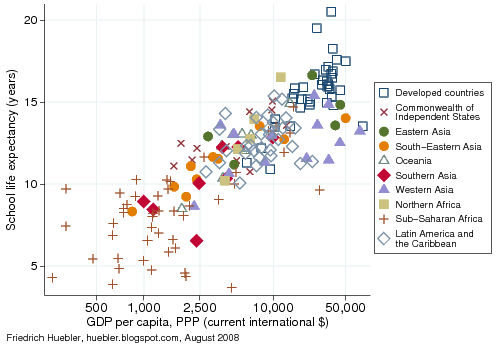
The graph below plots the school life expectancy against GDP per capita in 2006, the year with the most recent data. The GDP data was adjusted with purchasing power parities (PPP) to account for differences in the price levels between countries. To emphasize the shape of the relationship with school life expectancy the GDP data is plotted on a logarithmic scale. In total, data for 175 countries was available. Each country is identified by a marker that indicates the Millennium Development Goal (MDG) region in which it is located.

The graph clearly demonstrates that GDP per capita is positively correlated with school life expectancy. The upper right corner of the graph is populated mainly by developed countries with a high GDP per capita and a long school life expectancy. The countries with the highest school life expectancy are Australia (SLE 20.5 years, GDP per capita $35,500), New Zealand (SLE 19.5 years, GDP per capita $25,500), and Iceland (SLE 18.2 years, GDP per capita $36,900). The countries with the lowest school life expectancy are Angola (SLE 3.7 years, GDP per capita $4,400), Niger (SLE 3.9 years, GDP per capita $630), and the Democratic Republic of the Congo (SLE 4.3 years, GDP per capita $280). The Democratic Republic of the Congo has the lowest GDP per capita of all countries with data.

GDP per capita and school life expectancy, 2006
Scatter plot of school life expectancy and GDP per capita in 175 countries
Data sources: UNESCO Institute for Statistics, World Bank, UN Population Division.

The following table lists the average school life expectancy, the average GDP per capita, and the total population in each MDG region and for the world as a whole. At the global level, the average school life expectancy is 11.5 years and the average GDP per capita is $9,300. Developed countries have the highest school life expectancy (15.8 years) and the highest GDP per capita ($33,500). Countries in Latin America and the Caribbean and members of the Commonwealth of Independent States (the former Soviet Union) also have a high school life expectancy (13.5 years and 13.4 years, respectively) but at lower levels of GDP per capita ($9,100 and $9,400).

In Northern Africa, the average school life expectancy is 12.2 years, with a GDP per capita around $5,400. In Eastern Asia, South-Eastern Asia, Oceania, and Western Asia, the school life expectancy ranges from 11 to 11.4 years. Western Asia, which includes the oil-rich countries of the Middle East, is the region with the second highest GDP per capita ($11,400) but school life expectancy is the third lowest of all ten MDG regions. Southern Asia has the second lowest school life expectancy with 9.6 years and an average GDP per capita of $2,600. The lowest school life expectancy is observed in Sub-Saharan Africa (7.7 years) and this region also has the lowest GDP per capita ($1,800).

MDG regions: school life expectancy, GDP per capita, and total population, 2006
MDG region School life expectancy (years) GDP per capita, PPP (current international $) Total population (1,000)
Developed countries 15.8 33,508 1,015,487
Commonwealth of Independent States 13.4 9,371 278,295
Eastern Asia 11.4 5,471 1,402,837
South-Eastern Asia 11.3 4,190 565,105
Oceania 11.4 2,323 8,804
Southern Asia 9.6 2,649 1,612,841
Western Asia 11.0 11,394 200,205
Northern Africa 12.2 5,433 155,086
Sub-Saharan Africa 7.7 1,818 788,122
Latin America and the Caribbean 13.5 9,109 564,732
World 11.5 9,262 6,591,513
Data sources: UNESCO Institute for Statistics, World Bank, UN Population Division. Regional averages are weighted by each country's total population.

A related article on this site analyzes the link between national wealth and school enrollment at the primary and secondary level of education. Countries with a high GDP per capita usually have higher net enrollment rates than countries with a low GDP per capita. This relationship is particularly strong at the secondary level of education. Two articles on poverty and educational attainment in the United States examine poverty rates and high school graduation rates in the 50 U.S. states.

Data sources
Related articles
External links
Friedrich Huebler, 3 August 2008 (edited 28 August 2008), Creative Commons License
Permanent URL: http://huebler.blogspot.com/2008/08/wealth.html