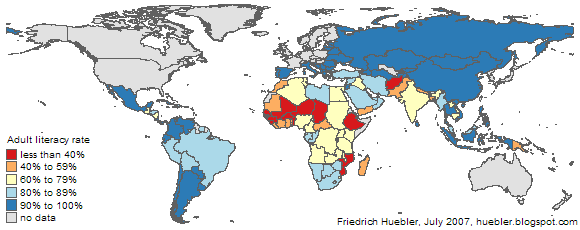
Last week, I posted an article on adult literacy with the latest statistics from the UNESCO Institute for Statistics (UIS). Today's article will look at the latest statistics on youth literacy. The youth literacy rate is the share of the population aged 15 to 24 years that is literate.
UNESCO provides national data on youth literacy for 133 countries. This compares to 137 countries for which the adult literacy rate is known. The youth literacy rate is usually higher than the adult literacy rate, especially in developing countries where the education system has expanded over the past decades. In a country where school attendance rates increase over time, persons born in a later year are more likely to attend school and to become literate.
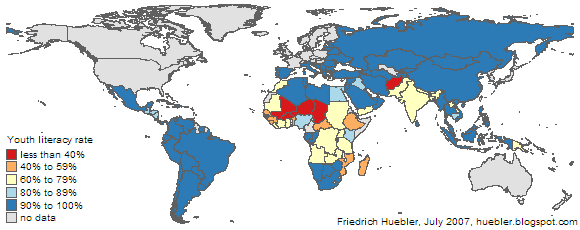
The map below displays the youth literacy rate for each country with data, ranging from 24.2 percent in Mali to 100 percent in Cuba. Most industrialized countries have no data on youth literacy, but school attendance is almost universal in these countries and literacy rates are therefore also high.
Youth literacy rates by country
Source: UNESCO Institute for Statistics, Data Centre, June 2007.
In Eastern Europe, East and Southeast Asia, and Latin America, youth literacy rates are generally 90 percent or higher. In some countries in Africa and the Middle East, youth literacy rates are also at or above 90 percent. Of 133 countries with data, 87 report youth literacy rates between 90 and 100 percent. 10 more countries have literacy rates between 80 and 90 percent.
In 5 countries, less than 40 percent of the population between 15 and 24 years are literate: Mali (youth literacy rate 24.2 percent), Burkina Faso (33.0), Afghanistan (34.3), Niger (36.5), and Chad (37.6). In 8 countries, the youth literacy rate is between 40 and 60 percent: Benin (45.3), Guinea (46.6), Mozambique (47.0), Sierra Leone (47.9), Senegal (49.1), Ethiopia (49.9), Madagascar (57.6), and the Central African Republic (58.5). In the remaining 23 countries, the youth literacy is between 60 and 80 percent.
The complete set of youth and adult literacy statistics is available at the UIS Data Centre.
Related articles
Friedrich Huebler, 15 July 2007 (edited 22 July 2007), Creative Commons License
Permanent link: http://huebler.blogspot.com/2007/07/youth-literacy-rates.html
UNESCO provides national data on youth literacy for 133 countries. This compares to 137 countries for which the adult literacy rate is known. The youth literacy rate is usually higher than the adult literacy rate, especially in developing countries where the education system has expanded over the past decades. In a country where school attendance rates increase over time, persons born in a later year are more likely to attend school and to become literate.
The map below displays the youth literacy rate for each country with data, ranging from 24.2 percent in Mali to 100 percent in Cuba. Most industrialized countries have no data on youth literacy, but school attendance is almost universal in these countries and literacy rates are therefore also high.
Youth literacy rates by country
Source: UNESCO Institute for Statistics, Data Centre, June 2007.
In Eastern Europe, East and Southeast Asia, and Latin America, youth literacy rates are generally 90 percent or higher. In some countries in Africa and the Middle East, youth literacy rates are also at or above 90 percent. Of 133 countries with data, 87 report youth literacy rates between 90 and 100 percent. 10 more countries have literacy rates between 80 and 90 percent.
In 5 countries, less than 40 percent of the population between 15 and 24 years are literate: Mali (youth literacy rate 24.2 percent), Burkina Faso (33.0), Afghanistan (34.3), Niger (36.5), and Chad (37.6). In 8 countries, the youth literacy rate is between 40 and 60 percent: Benin (45.3), Guinea (46.6), Mozambique (47.0), Sierra Leone (47.9), Senegal (49.1), Ethiopia (49.9), Madagascar (57.6), and the Central African Republic (58.5). In the remaining 23 countries, the youth literacy is between 60 and 80 percent.
The complete set of youth and adult literacy statistics is available at the UIS Data Centre.
Related articles
- Disparity between adult and youth literacy
- Adult literacy rates
- Years of schooling and literacy: Can everyone with primary education read and write?
- Years of schooling and literacy, part 2
- UNESCO releases data from 2006 education survey
Friedrich Huebler, 15 July 2007 (edited 22 July 2007), Creative Commons License
Permanent link: http://huebler.blogspot.com/2007/07/youth-literacy-rates.html