A view inside primary schools

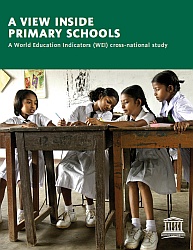
Cover of "A view inside primary schools" by UISA new publication by the UNESCO Institute for Statistics, A view inside primary schools: A World Education Indicators (WEI) cross-national study, presents new data on quality and equality in primary education. The data is from 11 countries in Asia, Latin America, and North Africa that participated in the Survey of Primary Schools by the World Education Indicators Programme in 2005 and 2006. For the survey, fourth grade teachers and principals from over 7,600 schools responded to questions about teaching and learning conditions.

The countries in the study - Argentina, Brazil, Chile, India, Malaysia, Paraguay, Peru, Philippines, Sri Lanka, Tunisia, and Uruguay - are close to the Millennium Development Goal of universal primary education. However, the survey reveals large resource gaps between schools in urban and rural areas. Children in poorly equipped and maintained schools often come from poor families and these children are thus doubly disadvantaged.

Other findings of the survey include:
  • In Paraguay, the Philippines, and Sri Lanka, more than one in five pupils attended schools without running water.
  • In India, Paraguay, Peru, the Philippines, Sri Lanka, and Tunisia, less than half of all pupils were in schools with a telephone.
  • Sri Lanka was the only country participating in the survey that provided free textbooks to virtually all pupils.
  • The overall weekly teaching load for Grade 4 teachers working in only one school ranged from 14 hours in Malaysia to 31 hours in Chile and the Philippines. The average teaching load was 23 hours per week.
  • In all countries in the survey - except in India, Malaysia, and Sri Lanka - most teachers expressed low levels of satisfaction with their salaries.
The full report, with detailed tables and figures, is available for download at the UIS website.

External links
Related articles
Friedrich Huebler, 27 July 2008 (edited 26 October 2008), Creative Commons License
Permanent URL: http://huebler.blogspot.com/2008/07/primary-schools.html
Updates to two Stata guides

A new section on troubleshooting was added to the guide to integrating Stata and external text editors. The guide describes a set of programs that can be used to run Stata commands from an external text editor. The installation of these programs is straightforward and users should not encounter any problems if the installation instructions are followed exactly. In case the programs do not work, the new section offers simple steps to track down the source of the problem. The guide to reading Statalist with Gmail was also updated to include information on a new "fixed width font" feature of Gmail.

Friedrich Huebler, 22 June 2008, Creative Commons License
Permanent URL: http://huebler.blogspot.com/2008/06/stata-guides.html

Adult literacy in 2007

The release of new literacy data by the UNESCO Institute for Statistics (UIS) in May 2008 provides an opportunity to update an article on adult literacy rates that was published on this site in July 2007. The adult literacy rate is the share of literate persons in the population aged 15 years and older. Compared to the previous analysis, literacy data for more countries and for more recent years is available. An article on literacy data from the UIS provides additional information on the latest UIS database.

Before the update of May, the UIS database contained adult literacy rates for 136 countries and territories. For 10 countries, the most recent data was from 2005, for 30 countries from 2004, and for 5 countries from 2003. The remaining countries had data from 2002 or earlier years.

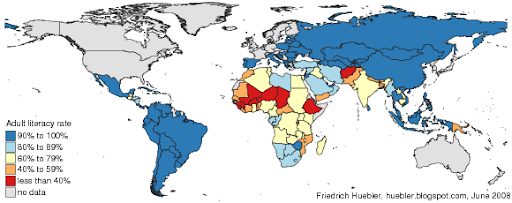
The UIS Data Centre now offers the adult literacy rate for 145 countries and territories. For 115 countries, data from 2007 is available. The map below displays the adult literacy rate for all countries with data.

Adult literacy rates by country, 2007
World map with adult literacy rates by country in 2007
Source: UNESCO Institute for Statistics, Data Centre, May 2008

The unweighted mean of the adult literacy rate is 81.2 percent. In 71 countries - including most of Eastern Europe, East and Southeast Asia, and Latin America - 90 percent or more of the adult population can read and write. The highest adult literacy rate, 99.8 percent, is reported for Cuba, Estonia and Latvia. Most countries without data are in the group of industrialized countries, where literacy rates are also likely to be above 90 percent. In 23 countries, the adult literacy rate is between 80 and 90 percent.

At the other extreme are eight countries with literacy rates below 40 percent: Mali (23.3), Chad (25.7), Afghanistan (28.0), Burkina Faso (28.7), Guinea (29.5), Niger (30.4), Ethiopia (35.9), and Sierra Leone (38.1). Another 16 countries have literacy rates between 40 and 60 percent: Benin (40.5), Senegal (42.6), Mozambique (44.4), Central African Republic (48.6), Cote d'Ivoire (48.7), Togo (53.2), Bangladesh (53.5), Pakistan (54.9), Liberia (55.5), Morocco (55.6), Bhutan (55.6), Mauritania (55.8), Nepal (56.5), Papua New Guinea (57.8), Yemen (58.9), and Burundi (59.3). Almost all of these countries are in Sub-Saharan Africa and South Asia.

Finally, the world's two largest countries in terms of population have very different literacy rates. In China, the adult literacy rate is 93.3 percent. In India, only 66 percent of the adult population can read and write.

The complete dataset with adult and youth literacy rates is available at the UIS Data Centre.

Related articles
External links
Friedrich Huebler, 15 June 2008, Creative Commons License
Permanent URL: http://huebler.blogspot.com/2008/06/adult-literacy.html